The 4 Elements of the Best Cohort-Based Programs
Sruti Bharat
CEO
Date & time
Cohort-based programs promote connection, learning, network effects. I wanted to share my perspective on a commonly asked question I’ve been getting this month from program managers – how do you design the best cohort experience?
A cohort experience aims to create a social network that can drive powerful outcomes for the host organizations. It’s chemistry: in order to create strong bonds, you have to facilitate comfort and trust, while also curating randomness and serendipity of meeting new people and learning new things. When this is done well, network effects look like sustained engagement of alumni, wonderful testimonials, strong word of mouth and referrals, and future cohorts that end up being even stronger. Universities have figured this out to a tee!
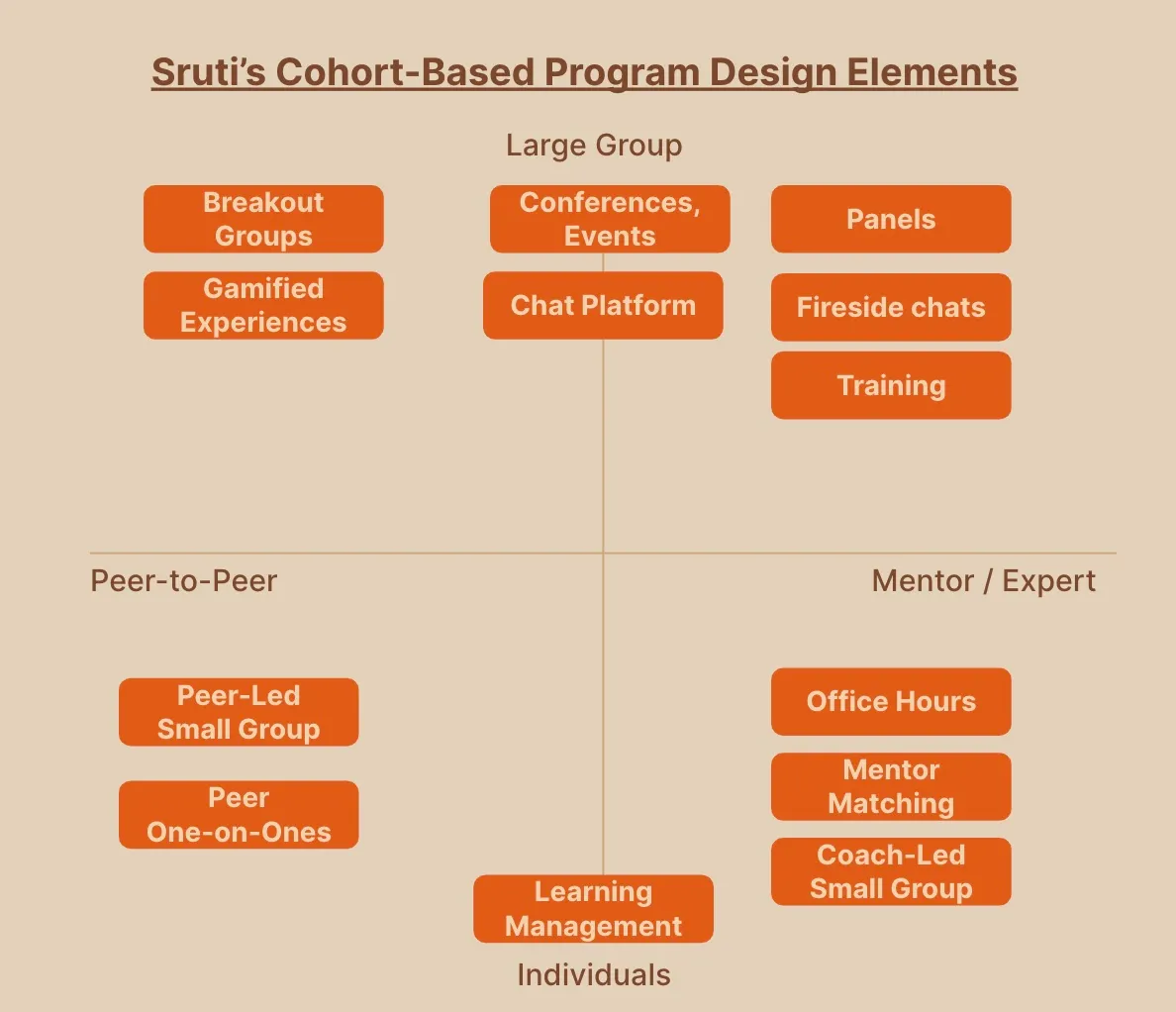
In my experience, best-in-class cohort-based programs blend 4 elements of engagement (enjoy the dorky 2x2):
Large group mixing
Mentor/expert engagement
Peer-to-peer relationship building
Individual learning and access to resources
Large Group Mixing: The All Raise VC Summit I used to lead is a great example of a “big tent” event where the full community comes together once a year to feel energized, inspired, and connected.
Mentor / expert engagement is something MBA programs do really well for large groups: bringing industry experts into class, hosting Fireside Chats with executives. On the more intimate side of the expert continuum, Work on Climate hosts an “Expert Office Hours” program which allows individuals to meet experts one-on-one, promoting network expansion and mentorship.
Peer-to-peer relationships are the fundamental bond…and they don’t happen by accident. For this cohort of FutureMap’s Career Community of Practice, I curated matches between members and suggested 3 topics for a virtual Coffee Chat; folks appreciate the accountability and thoughtfulness of the match.
Individual learning and access to resources involve great platforms and tools, self-paced courses, Notion wiki pages, and other ways to self-serve. As an On Deck founder fellow, I love their homegrown platform plus Slack channel where I can search for questions and answers specific to my needs.
All of these take an immense amount of time and capacity to get right, but when blended together and staffed appropriately, the effects compound.
The pitfalls of having all these options
In my experience there’s a cycle of doom when it comes to program design.
Stakeholders (read: management) love adding program elements on the fly… “Why don’t you just match everyone in the cohort with a mentor? People love that.” “Why don’t we add some in-person mixers?”
…program managers overcommit without considering capacity; stakeholders fail to realize how much work it takes to execute even ONE element of a program well
Because program managers are constantly in a cycle of doing manual operational work, there’s never any time to properly collect data and impact to know what really worked and what didn’t…
Leading to the same problem in the next cycle
Bottom line — It’s better to execute 1-2 of these elements really well vs. overcommitting and risking burnout or poor quality.
How do you decide which elements you should do, and which to discard?
This comes back to program goals. Ideally the PM answers strategic questions first before picking and choosing the design elements:
What are program goals and outcomes?
Who is the target participant?
Based on those items, how will you curate a cohesive program experience (onboarding, engagement, offboarding)?
If the program goal is primarily learning, secondarily connection, perhaps you dial up the expert-led large-group learning sessions and provide an excellent learning management offering for individuals to follow along.
If the program goal is some kind of internal transformation as well as a sense of community, maybe your core offering consists of small groups that allow individuals to build relationships with other individuals or work with a coach.
If the program goal is network growth as a driver of important outcomes like employment, then perhaps you maximize one-on-one or small group mixing within the context of a large event.
There are so many ways to mix and match that it is important to remember what you are trying to achieve, and then pick the program that you’re able to execute well with the resources you have.
Do you find this relatable? Want to dive deeper? Drop me a note at sruti@campground.fyi!
Social Impact Programs Deserve Better.
How Campground is Moving the Sector from Spreadsheets to Systems
Read article
Camp Counselor of the Month from American Connection Corps
Making Service Corps Program data management fun
Read article
Hayward Promise Neighborhood: A Shared System for Multiple Partners to Support Families
Reducing Chronic Absenteeism through Coordination...and One Hub
Read article
Data Privacy for Tiny Nonprofits: Campground > Spreadsheets
Campground's an easy-to-use way to secure student data
Read article